Through the Lens of Kinshasa: Where the City Breathes in Frames
You know that feeling when a city just speaks to your camera? Kinshasa does that—hard. I didn’t expect this chaotic, vibrant heartbeat of Central Africa to offer such raw, unfiltered viewpoints. From sunrise over the Congo River to rooftop shots in Gombe, every angle tells a story. Photography here isn’t just clicking pictures—it’s capturing survival, rhythm, and resilience. This is real. This is Kinshasa. More than a destination, it’s a visual awakening, where light dances on corrugated roofs and life unfolds in unscripted moments. For the thoughtful traveler with a lens, Kinshasa offers not postcard perfection, but something deeper: truth in motion.
The Pulse of a Photographic Journey
Kinshasa is not a city designed for the passive observer. With over 15 million souls shaping its daily rhythm, it pulses with a raw energy that defies conventional travel photography. This is not a place of manicured parks or silent plazas. Instead, it thrives on movement—motorbikes weaving through traffic, vendors balancing baskets on their heads, children laughing in alleyways, and the ever-present hum of music drifting from open windows. For photographers, this chaos is not a barrier but an invitation. The unpredictability of street life, the layered textures of weathered walls, and the kaleidoscope of colors in clothing and market goods create a dynamic canvas unlike any other.
What sets Kinshasa apart is how its urban fabric tells stories without words. A cracked façade might hint at decades of resilience. A hand-painted sign on a corner shop reveals local entrepreneurship. The way sunlight filters through laundry strung between buildings becomes a study in composition and light. Photography here shifts from mere documentation to storytelling. Each frame captures not just a moment, but a thread in the city’s larger narrative—of survival, adaptation, and joy amid complexity. The city’s density, often seen as overwhelming, actually enhances photographic opportunities, offering layers of human activity within a single shot.
For travelers accustomed to curated destinations, Kinshasa demands a different mindset. It asks photographers to slow down, observe deeply, and engage with authenticity. The city does not perform for the lens; it simply lives. And in that unfiltered reality lies its visual power. By embracing the messiness—the dust, the noise, the spontaneity—photographers gain access to a truth that polished tourist spots often obscure. This is not about finding perfection, but about honoring presence. Kinshasa redefines what it means to see an African megacity: not as a challenge to overcome, but as a living, breathing subject worthy of respect and wonder.
Why Viewpoints Matter in Urban Storytelling
In any city, a skyline offers more than just a pretty picture—it provides context. In Kinshasa, where geography, history, and social dynamics are deeply intertwined, the choice of viewpoint becomes a powerful storytelling tool. Elevation changes not only the angle of the shot but also the depth of understanding. From above, the city’s layout along the Congo River reveals patterns invisible at street level: the way neighborhoods cluster along ridges, how transportation routes snake through communes, and where green spaces—or their absence—shape daily life.
Viewpoints offer a rare chance to see contrasts that define urban life in Kinshasa. From a mid-rise building in Ngaliema, one might capture the sharp divide between tree-lined avenues in affluent districts and the tightly packed housing of neighboring communes. These visual contrasts are not just aesthetic—they reflect deeper realities of access, infrastructure, and economic disparity. A photograph taken from height does not judge, but it can illuminate. It allows the viewer to grasp the city’s complexity in a single frame, seeing how rivers, roads, and residential zones interact in a delicate, often strained balance.
Moreover, aerial perspectives help document the informal economy that sustains much of the city. From above, one can spot open-air markets expanding into parking lots, street vendors organizing their stalls in geometric precision, or clusters of food carts near transit hubs. These scenes, often overlooked in official city planning, are the lifeblood of daily survival for millions. A well-chosen vantage point turns a simple panorama into a social document, revealing how people adapt, innovate, and thrive within the city’s constraints. In this way, photography becomes a form of urban anthropology, capturing not just how Kinshasa looks, but how it functions.
Yet, the value of elevation is not only in grand panoramas. Even a slight rise—a staircase, a bridge, or a second-floor balcony—can shift perception. It allows the photographer to see beyond immediate chaos and recognize patterns, rhythms, and relationships. In a city where information moves by word of mouth and infrastructure evolves organically, these visual insights are invaluable. They help travelers move beyond stereotypes and appreciate Kinshasa not as a place of disorder, but as a highly organized, if unofficial, ecosystem of human resilience.
Rooftop Culture in Gombe: The Photographer’s Playground
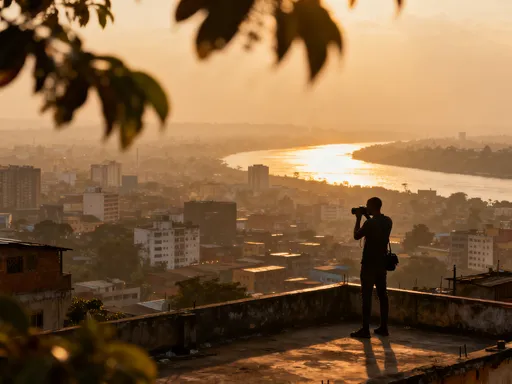
Nestled in the heart of Kinshasa’s administrative district, Gombe holds one of the city’s best-kept visual secrets: its rooftops. While not widely advertised, many mid-rise buildings offer access to elevated spaces that provide sweeping east-west cityscapes. These urban perches are not tourist attractions, but functional extensions of daily life—places where residents gather in the evening, children play, and laundry dries under the sun. For photographers, they represent rare vantage points to capture the city’s architectural layers, from colonial-era facades to modern concrete towers, all under the ever-changing African sky.
The magic of Gombe’s rooftops peaks during golden hour. As the sun dips behind the western hills, light spills across the city in warm amber waves, illuminating rooftops, reflecting off glass windows, and casting long shadows across narrow streets. This is the moment when Kinshasa transforms—its grit softened by light, its energy tempered by stillness. A wide-angle lens can capture the vastness of the urban sprawl, while a telephoto lens isolates details: a woman preparing dinner on a balcony, a group of friends sharing a meal, or the silhouette of a church steeple against the fading light.
Accessing these rooftops requires respect and local guidance. Simply walking into a building and heading upstairs is not advised. Instead, photographers should seek permission from building managers or residents, often through a local fixer or guide. These intermediaries not only help navigate language barriers but also ensure cultural sensitivity. In many cases, a small courtesy fee or shared drink is appreciated, not as a transaction, but as a gesture of goodwill. Building trust is essential—not just for access, but for authentic representation. When people understand your intent, they are more likely to welcome your presence, knowing you seek to honor, not exploit, their environment.
Safety is also a consideration. While Gombe is one of Kinshasa’s more secure neighborhoods, rooftops may lack railings or proper lighting. It’s wise to visit during daylight or early evening, avoid unstable structures, and never go alone. Carrying a flashlight, wearing non-slip shoes, and keeping equipment secure are practical steps that ensure a smooth experience. More importantly, maintaining a low profile—avoiding loud conversations or flashy gear—helps prevent unwanted attention. The goal is not to dominate the space, but to blend into it, observing quietly and capturing moments with humility.
The Congo River as a Living Horizon
The Congo River is not merely a geographic boundary between Kinshasa and Brazzaville; it is a living stage where daily life unfolds in poetic motion. Along the riverbanks in neighborhoods like Kintambo, Barumbu, and Funa, fishermen launch their pirogues at dawn, their silhouettes cutting through the morning mist. Women wash clothes on flat stones, children bathe in shallow waters, and traders load goods onto barges bound for upstream villages. These riverside scenes offer some of the most cinematic and emotionally resonant opportunities for photography in the city.
For photographers, the river provides a natural frame—a horizontal line that divides sky and land, stillness and movement. At sunrise, the water catches fire with hues of orange and pink, creating perfect conditions for long-exposure shots. A tripod and a slow shutter speed can turn rippling waves into a glassy mirror, reflecting the sky and the distant skyline of Brazzaville. The contrast between the calm water and the dynamic activity on shore creates visual tension that draws the viewer in. Even without specialized equipment, the interplay of light and shadow during early morning or late afternoon offers rich tonal variation, ideal for black-and-white conversions.
The rhythm of river life follows its own tempo. Fishermen return with their catch around mid-morning, their nets heavy with tilapia and catfish. This is a prime moment for candid photography—faces marked by sun and labor, hands sorting fish, baskets filling up. Later in the day, the river becomes a social space. Families gather to escape the heat, couples stroll along the shore, and local vendors sell grilled fish and cold drinks. These moments of leisure are as telling as the labor of the morning, revealing how the river serves not just as a source of income, but as a communal heart.
Timing is crucial when photographing the river. Midday light is harsh and flat, washing out colors and creating unflattering shadows. The best hours are the first and last 90 minutes of daylight, when the sun is low and the air is cooler. It’s also wise to check tidal patterns, as water levels can affect accessibility to certain spots. Some areas become muddy or slippery at low tide, while others may flood during heavy rains. Wearing appropriate footwear and carrying a small towel for equipment are small but essential precautions. Most importantly, photographers should approach riverside communities with respect. Asking permission before photographing individuals, offering a smile or a greeting, and avoiding intrusive behavior go a long way in building trust and ensuring a positive experience for everyone involved.
Highways and Hilltops: Finding Elevation Beyond the Center
While Gombe and the riverfront offer iconic views, Kinshasa’s true depth reveals itself beyond the city center. Elevated roads like the Boulevard du 30 Juin and the Avenue de l’Hôpital provide dynamic vantage points for capturing the city’s relentless motion. From these overpasses, one can photograph the endless flow of traffic—buses painted in vibrant colors, motorcycle taxis weaving through lanes, pedestrians crossing with practiced nonchalance. These images convey not just movement, but the city’s pulse, its refusal to stand still.
Further out, neighborhoods like Lingwala, Kalamu, and Matonge sit on gentle slopes that naturally elevate the observer. These areas are often overlooked by visitors, yet they offer some of the most authentic and visually rich perspectives. From a quiet street in Lingwala, a photographer can frame a sweeping view of lower-lying communes, where rooftops stretch into the distance like a sea of metal and tile. The contrast between the orderly grid of streets above and the organic sprawl below tells a story of urban growth shaped by necessity rather than planning.
Reaching these viewpoints often requires local knowledge. Public transportation, such as minibuses or motorcycle taxis, can get you close, but knowing where to get off and which path to take makes all the difference. A trusted guide or fixer can help navigate these areas safely and efficiently. Once on site, patience becomes the most valuable tool. Waiting for the right light, the right moment—a child running home from school, a street vendor closing shop—transforms a simple view into a narrative. A 50mm or 35mm lens works well here, offering a natural field of view that captures both detail and context.
These outer viewpoints also highlight Kinshasa’s relationship with nature. Despite its density, the city is dotted with pockets of green—mango trees lining streets, makeshift gardens on vacant lots, and the occasional patch of forest preserved on a hillside. From elevation, these green spaces stand out as oases, reminders that life persists even in the most urbanized zones. Photographing them alongside the built environment creates a balanced portrayal of Kinshasa—one that acknowledges its challenges while celebrating its resilience and adaptability.
Capturing Humanity: Viewpoints with a Human Face
The most powerful photographs are not taken from above, but at eye level—where stories unfold in real time, face to face. In Kinshasa, the heart of the visual journey lies in its people. Markets like Marché Gambela, public squares like Place de la Nation, and neighborhood street corners are stages where daily life plays out with honesty and warmth. A musician tuning his guitar, a tailor at his sewing machine, a grandmother braiding her granddaughter’s hair—these moments, fleeting and unposed, carry more weight than any skyline.
Photographing people requires a different kind of lens—one of empathy and respect. While candid shots can be compelling, they risk reducing individuals to props in someone else’s narrative. A more ethical approach involves engagement. A simple greeting in Lingala, a smile, a moment of conversation—these small gestures can open doors. When people feel seen as individuals, not subjects, they are more likely to welcome the camera. In many cases, asking permission is not just courteous; it is necessary. A nod, a thumbs-up, or a verbal “yes” creates a shared moment, transforming the photograph from observation to collaboration.
Marché Gambela, one of the city’s largest markets, is a microcosm of Kinshasa’s spirit. Here, women sell everything from dried fish to handmade baskets, their stalls a riot of color and texture. The air hums with bargaining, laughter, and the rhythmic pounding of mortars and pestles. To photograph here is to document resilience in action. But it also requires sensitivity. Some vendors may not want their faces shown, especially if they are handling money. A discreet approach—focusing on hands, goods, or the interplay of light and shadow—can still convey the market’s energy without overstepping boundaries.
Similarly, in public spaces like Place de la Nation, where people gather to socialize, protest, or simply rest, photographers must read the mood. During quiet moments, a portrait of an elder reading a newspaper or children playing soccer can be deeply moving. During larger events, discretion is key. Respecting personal space, avoiding intrusive zooming, and being mindful of political or religious sensitivities ensures that photography remains a force for connection, not conflict. In the end, the best images are those that honor the dignity of their subjects, capturing not just how they look, but how they live.
Gear, Light, and the Kinshasa Rhythm: Practical Photography Tips
Photographing Kinshasa demands preparation, not just in equipment, but in mindset. The city’s climate—hot, humid, and dusty—can challenge even the most durable gear. A weather-sealed camera body and lenses are ideal, but not essential. More important is protection: lens caps when not in use, a microfiber cloth for constant cleaning, and a sealed bag for storage at night. Dust is the silent enemy, finding its way into every crevice, so regular maintenance is crucial. Carrying a small blower and brush can save hours of post-trip cleaning.
When it comes to lenses, simplicity often wins. A 35mm prime lens offers a natural field of view, perfect for street photography and environmental portraits. It forces the photographer to move, to engage physically with the scene. A 24-70mm zoom provides flexibility for tighter shots or wider scenes, useful in dynamic environments. Telephoto lenses are less necessary in dense urban areas, where proximity is part of the experience. A tripod is invaluable for riverside long exposures or rooftop night shots, but should be compact and easy to carry.
Light in Kinshasa is both a gift and a challenge. The equatorial sun is intense, creating harsh contrasts and blown-out highlights. The golden hours—shortly after sunrise and before sunset—are the most forgiving, offering soft, directional light that enhances texture and depth. Overcast days, often dismissed, can be ideal for even lighting and vibrant colors. In low-light situations, such as evening markets or dimly lit interiors, a higher ISO setting (1600–3200) may be necessary. Modern cameras handle noise well, and a slightly grainy image is preferable to a blurry one.
Navigating security with equipment requires awareness. While Kinshasa is generally welcoming, carrying expensive gear openly can draw unwanted attention. Using a discreet bag, avoiding touristy behavior, and keeping cameras close in crowded areas are basic precautions. At checkpoints, remaining calm and cooperative is essential. Most officers are not interested in confiscating equipment, but a respectful attitude goes a long way. Finally, backing up photos daily—using a portable hard drive or cloud storage—protects against loss due to theft, damage, or technical failure. In a city where every moment counts, preserving your work is as important as capturing it.
Framing the Unfiltered Soul
Kinshasa does not perform for cameras—it lives. And that is precisely its power. The city’s most meaningful viewpoints are not measured in meters above sea level, but in depth of perspective. By choosing empathy over spectacle, photographers do more than document; they connect. They become witnesses to a rhythm older than tourism, a resilience deeper than headlines. In a world increasingly shaped by filtered perfection, Kinshasa stands as a reminder that beauty thrives not in polish, but in presence—in the unguarded laugh, the weathered hand, the golden light on a rusted roof.
To photograph Kinshasa is to accept its contradictions. It is chaotic and orderly, struggling and thriving, fragmented and whole. It challenges the lens to see beyond surface noise and recognize the quiet dignity in everyday acts. A woman carrying water, a boy flying a kite from a hilltop, a choir singing in a modest church—these are not scenes of poverty, but of life lived fully, with creativity and courage.
The city teaches photographers to slow down, to listen, to wait. It rewards patience with moments of pure authenticity—glimpses into a world that refuses to be simplified. And in that refusal lies its truth. Kinshasa does not need to be fixed, framed, or explained. It simply is. And in that being, it offers one of the most profound photographic experiences on the continent: the chance to see not just a city, but a soul—unfiltered, unafraid, and utterly alive.